

Cross-Reference Guide: Mapping OEM Part Numbers to High-Efficiency Replacement Filters

Compressor Filter Cross Reference Fundamentals
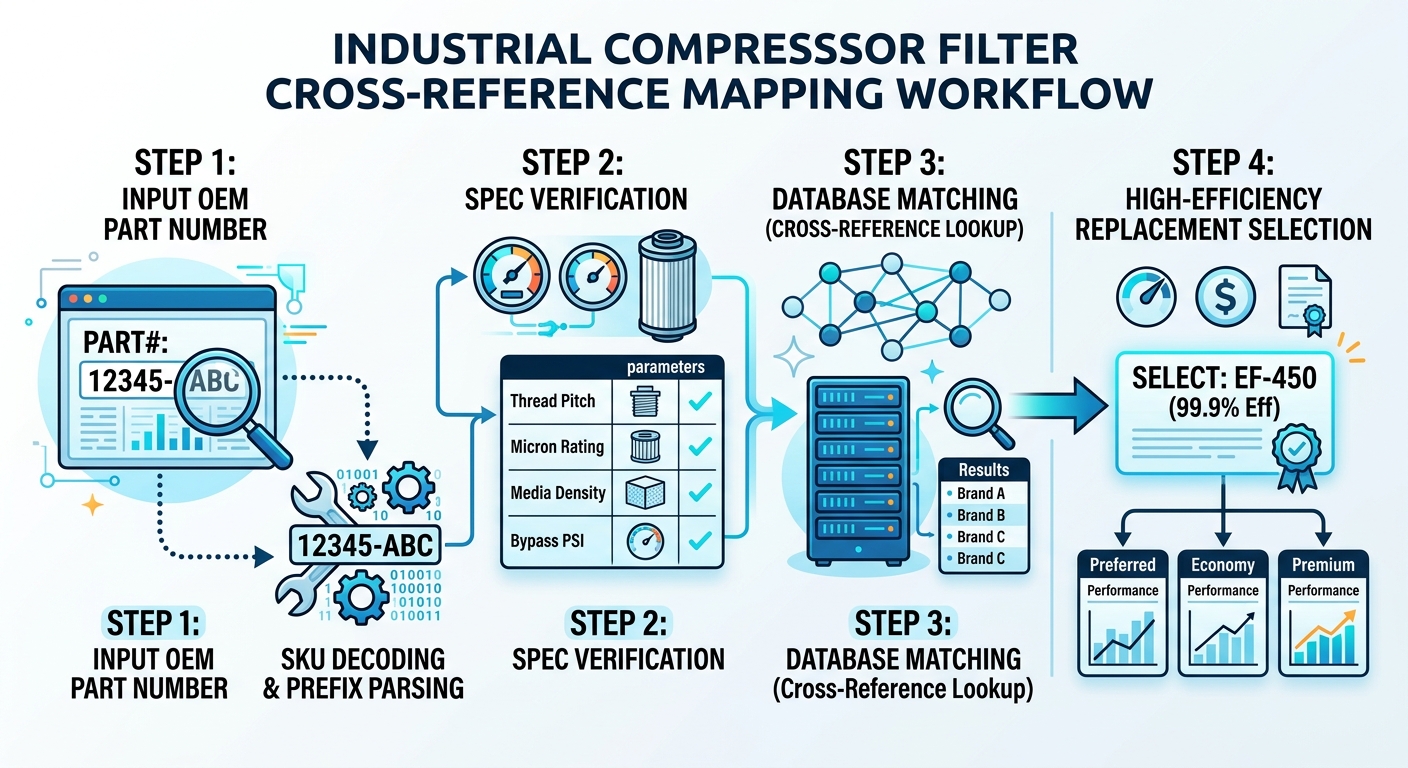
A compressor filter cross reference is the technical process of matching original equipment manufacturer (OEM) part numbers—such as those assigned by equipment manufacturers or specialized filter producers like MANN-FILTER—to equivalent, high-efficiency aftermarket or direct replacement air, oil, and air/oil separator filter elements. To execute an accurate compressor filter cross reference, plant engineers and MRO buyers must verify four critical technical specifications beyond part number string matching: physical thread dimensions and gasket sealing geometry, micron rating efficiency (such as beta ratios or ISO 12500 testing standards), media type (e.g., synthetic micro-glass vs. cellulose paper), and rated flow capacity (CFM or m³/min) at low initial differential pressure (ΔP). Cross-referencing through verified databases, like EL-AIR’s extensive parts cross-reference index, allows facility managers to lower maintenance overhead and eliminate lead-time delays while maintaining or improving air purity and operational reliability across mixed-brand compressor fleets.
2>Understanding OEM Part Numbering Schemas Across Major Compressor Brands
Navigating part numbers from various compressor original equipment manufacturers requires an understanding of how distinct brands structure their stock keeping units (SKUs) and product designations. Manufacturers rarely design consumable filter media entirely from scratch; instead, they specify engineering constraints for media density, burst strength, and bypass parameters, then assign an internal alphanumeric code.
Decoding Suffixes, Prefixes, and Revisions
Part numbers often contain embedded data indicating media grade, filter element generation, or physical modifications. For example, in automotive and industrial filtration lines like MANN-FILTER, prefix designations such as C (Air Filters), W (Oil Filters), or LB (Air/Oil Separators) explicitly identify component function, while sequential numeric blocks define housing shell dimensions and thread pitches. In OEM rotary screw environments, a revision letter attached to the end of a core sequence (e.g., ending in -A vs -B) may indicate a transition from traditional cellulose media to synthetic microfiber, or a change in gasket durometer to handle higher operating discharge temperatures.
Facility maintenance teams managing mixed fleets frequently encounter superseded numbers where an OEM has updated a part number due to vendor consolidation or design optimizations. A comprehensive cross-reference methodology accounts for these historical supersessions, mapping outdated or obscure part codes directly to current production replacement elements without losing track of essential tolerance parameters.
Cross-Referencing Micron Ratings, Thread Sizes, and Media Specifications
Matching a physical filter element requires more than finding an identical housing shape. Installing a replacement filter that matches external dimensions but lacks matching internal specs can lead to severe operational issues, such as fluid starvation, elevated oil aerosol carryover, or premature element collapse. Maintenance engineers must evaluate three primary technical criteria during any cross-referencing evaluation:
1. Physical Dimensions and Gasket Sealing Geometry
For spin-on filters and inline cartridges, mechanical compatibility hinges on precise physical dimensions:
- Thread Pitch and Diameter: Spin-on oil filters typically utilize metric (e.g., M20x1.5, M32x1.5) or standard UN/UNF threads. Installing a near-match thread can strip housing threads or result in catastrophic blow-offs under pressure.
- Gasket Contact Area: Gasket inner diameter (ID), outer diameter (OD), and durometer hardness dictate seal integrity under system vibration and thermal cycling. A mismatch in seal width or placement causes fluid leakage around the mounting base.
- Filter Height and Clearance: Length variations alter internal sump volume or prevent outer filter housings from sealing correctly.
2. Media Type and Micron Efficiency Ratings
Filter media determines particle retention capability. A common mistake during cross-referencing is treating nominal micron ratings as absolute indicators of performance. Engineers must evaluate media density and structure:
- Cellulose vs. Synthetic Micro-Glass: Standard cellulose media offers basic protection but breaks down under high heat or water exposure. Synthetic micro-glass provides higher dirt-holding capacity, finer absolute particle capture, and lower flow resistance.
- Nominal vs. Absolute Retention: A nominal 10-micron filter captures approximately 50% to 60% of particles at that size, whereas an absolute-rated element (e.g., Beta 1000) captures 99.9% of target particulate. Ensuring equal or superior retention efficiency prevents premature wear on screw rotors and sleeve bearings.
3. Internal Bypass Valve Pressure Settings
Rotary screw air compressor oil filters frequently feature built-in bypass valves. If cold fluid viscosity causes excessive pressure drop across the media during a winter startup, the bypass valve opens to ensure uninterrupted lubrication to the screw air end. Cross-referenced oil filters must match the original opening pressure threshold (typically between 1.5 to 2.5 bar / 21 to 36 PSI). A bypass set too low allows unfiltered oil to continuously circulate, while a bypass set too high causes element crushing or oil starvation during cold starts.
Identifying Direct Aftermarket Equivalents Using Digital Database Tools
Cross-referencing high-volume compressor fleets manually using paper catalogs or disparate PDF spec sheets increases the risk of part ordering errors. Digital cross-reference tools streamline this process by comparing verified dimensional and performance datasets across thousands of OEM part numbers.
EL-AIR maintains a large, continually updated cross-reference database that maps legacy, current OEM, and aftermarket filter designations to exact replacement specifications. By inputting part numbers from brands like MANN-FILTER or legacy compressor labels into a central cross-reference system, procurement managers instantly identify high-efficiency options that align with original design criteria.
Overcoming Regional Variants and Private-Label Masking
Compressor distributors frequently private-label replacement filters, placing proprietary stickers or custom stock numbers over standard component codes. Digital lookup databases assist plant engineers in peeling back private-label layers by matching verified housing dimensions, media density specs, and end-cap geometries to reveal the universal functional replacement part.
Verifying Differential Pressure and Flow Rate Compatibility
Before installing a cross-referenced air intake or oil filter, engineers must verify that the replacement element maintains proper system flow dynamics. Operating a compressor system with an undersized or restrictively media-packed filter increases differential pressure (ΔP), raising energy usage across the facility.
Impact of Initial Differential Pressure (ΔP)
Every filter element imposes a slight restriction to airflow or oil passage when clean. High-efficiency replacement elements utilize pleating architectures optimized for high surface area, yielding low initial pressure drops. For air intake filtration, every additional 25 mbar (10 inches of water column) of inlet restriction reduces compressor air delivery capacity by roughly 1% while increasing motor power consumption.
Ensuring CFM and Viscosity Flow Ratings Match
Cross-referenced inline air filters and coalescing elements must be matched to system flow capacity (CFM) at minimum operating pressures. If a replacement coalescing filter element cannot handle the full volumetric flow rate of the system, flow velocity through the media increases beyond critical limits, leading to liquid re-entrainment and elevated oil aerosol carryover in downstream process air.
By verifying flow rate capacity, thread geometry, bypass settings, and filtration efficiency, plant maintenance teams can substitute high-efficiency replacement filters across all compressor makes and models without compromising machine lifespan or air purity.
Facility maintenance managers seeking precise filter matches for their air systems can contact EL-AIR to consult technical specs or request a quote for cross-referenced replacement filters.

